America Is Going to Seize Kharg Island — It’s The Last Best Option
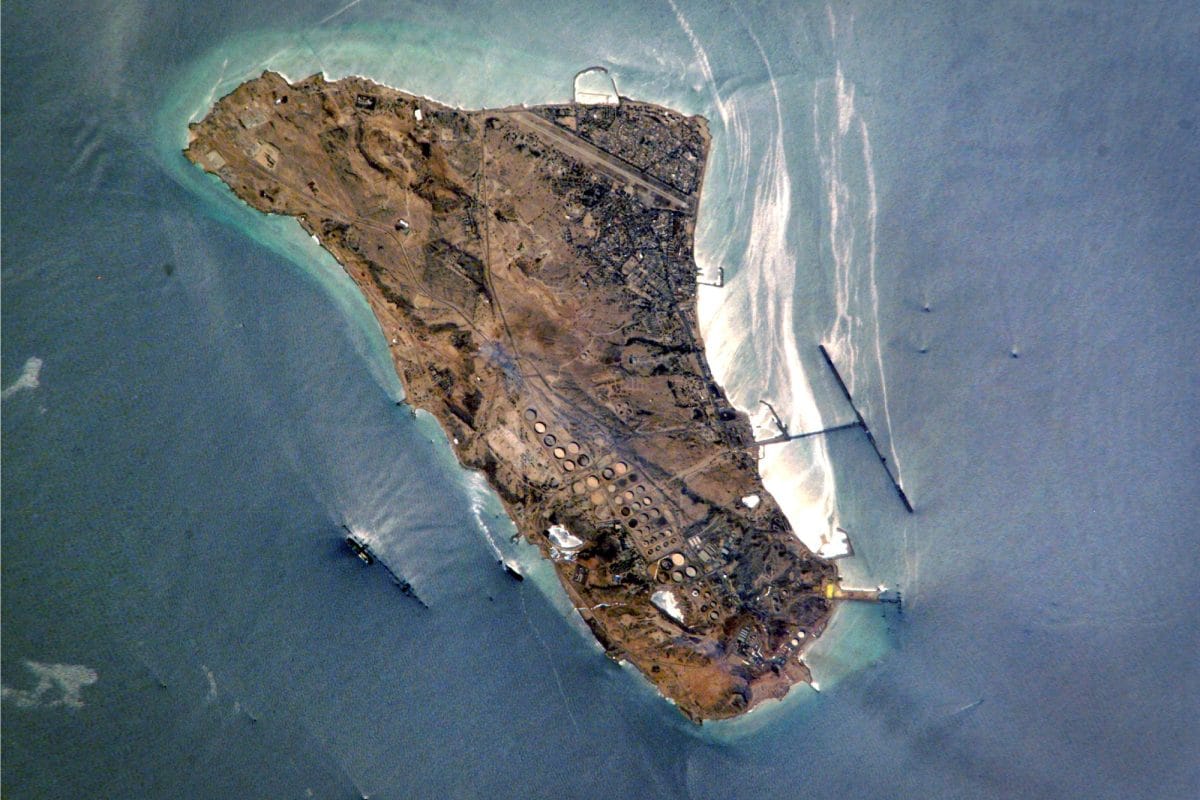
90% of Iran's energy revenues flow through a single island the size of Manhattan. The United States Air Force could turn it to glass in an afternoon. But it hasn’t been destroyed yet because you don’t kill a hostage when they’re more valuable alive than dead.
At the moment, why we find ourselves in this position is immaterial. Autopsies can be run after the crisis has passed. Focus is required on what comes next, why, and how to escape global economic meltdown. And another hit to the prestige of American power.
The Strait Math
The Strait of Hormuz is 180 kilometers long. At its narrowest, 45 kilometers wide. Two shipping lanes, each 3.2 kilometers across with a 3.2-kilometer buffer. Giving a targeting area of 9.6 kilometers. Through that corridor moves roughly 20% of the world's traded oil. Extended closure removes a quarter of global supply from the market — per EIA estimates.
In 1990, the mere threat of Iraqi interdiction doubled the world oil price. Iraq's mine-laying off the Kuwaiti coast in 1991 was sufficient to deter a U.S. amphibious assault — and Iraq used only conventional mining doctrine. Iran has spent the subsequent three decades building something far more dangerous: an estimated several hundred anti-ship cruise missiles, mobile truck-mounted batteries dispersed across an area three times the size of Kosovo, and a layered mine warfare capability that U.S. MCM assets are structurally unprepared to defeat.
Japan, South Korea, Taiwan, and the Philippines — highly dependent on Gulf energy — lack the strategic reserves to sustain a prolonged closure. Europeans, forced to buy Russian energy as an alternative, are now indirectly financing Moscow's war in Ukraine. The Strait must reopen. The question is how.
The Mine Problem
Iran's mine inventory is the first lever of denial. The Strait is shallow with strong currents — conditions that favor moored or bottom-influence mines over contact mines, which can be swept once located. Iran's three Kilo-class submarines (Type-877, Russian-sourced) can each carry 24 mines, specifically the MDM-6: a 1,100 kg influence mine that responds to acoustic, magnetic, and pressure signatures within a 50–60 meter radius. It includes a ship counter and timing device — meaning Iran retains tactical control over when mines activate. According to the brilliant Caitlin Talmadge, two operational Kilos could execute eight mine-laying sorties and emplace 192 MDM-6 mines across both lanes and the buffer zone, covering the mouth of the Strait, east of the Tunb Islands, and south of Larak Island. An additional 167 smaller surface craft, each laying an average of three M-08 mines at night, could seed another 501 mines in the western channels.
While the United States is watching the strait, there’s no way to guarantee that more mines or no mines are active in the Strait.
Further, the U.S. MCM response capacity is degraded. Operation Candid Hammer — the gold standard — cleared 907 Iraqi mines off Kuwait in 1991 using 15 ships over 51 days, in a fully permissive environment, with Iraqi generals handing over minefield maps..
In a contested environment against influence mines requiring precise signature mimicry to neutralize, that rate falls materially. The Avenger-class ships stationed at Manama were decommissioned at the end of 2025. The LCS MCM package has never seen combat. Allied MCM support — which provided roughly 50% of Candid Hammer's capacity — is not guaranteed in this political environment. MCM operations indicate it could take a month or more to reopen the Strait even against a small mine-laying campaign. Iran has the capability to mine the Strait, and only needs an effective campaign, not a large one.
The Missile Problem
Mines create panic and psychological fear, which requires MCM operations to solve. And while U.S. warships could easily conduct MCM in an uncontested environment, that is not the case today in the Strait.
Anti-ship cruise missiles (ASCM) pose a significant threat to escorting tankers and to MCM operations aimed at clearing those mines. Iran's ASCM inventory includes the C-802 Saccade (sea-skimming, subsonic, 120 km range), C-801 Sardine (8–42 km), CSS-N-2 Silkworm and CSS-N-3 Seersucker (95 km range), and reported SS-N-22 Sunburn systems. These are dispersed across an estimated 15–25 mobile Saccade/Sardine batteries and 12 Silkworm/Seersucker batteries across 16,500 square kilometers of Iranian coastline — plus forward island bases including Qeshm, where 60 of 75 Saccade missiles were reportedly concentrated.
The targeting math is brutal. Each battery emits radar for 4–5 minutes before going silent and relocating. Sensor-to-shooter response using AWACS and tactical aircraft requires sustained two-carrier operations. Even at a 100% kill rate, 36 batteries, launching twice daily, would require 18 days to be destroyed entirely. Iran's optimal strategy is to launch infrequently — stretching the hunt while maintaining threat credibility. (Which may be the reason we haven’t seen a non-stop response from the Iranians.) MCM ships are more vulnerable to shore-based fire than tankers.
Simply put, the United States will not risk lives and assets plowing through the strait when only one mine needs to work, and there's uncertainty if there are any ASCM assets operational around the strait.
The Options Landscape
Outside of a magic trick (which is always possible with this administration), the United States has three options:
Walk away- which is a possibility, but isn’t a real choice. No Western P&I insurer will cover vessels transiting a strait controlled by a regime that just suffered targeted strikes on its leadership, per gCaptain analysis. The Strait reopens commercially only under a U.S. guarantee. Leaving an angry and capable regime in control is unacceptable to the GCC, Israel, and every Asian ally dependent on Gulf flows.
And the United States cannot afford to abandon its folly in today's geopolitical world. Failing to control the Strait after starting this intense campaign will demonstrate to the world that American power is insufficient. And that America can't finish what it starts. (I wish we weren't here, but here we are.)
MCM Operations and tanker escorts: A difficult option to successfully execute with lots of downside risk. The environment is still contested, and the probability calculus on billion-dollar hulls with thousand-man crews through a 9.6-kilometer channel is unfavorable even at sub-1% strike probability. As the New York Times documented, the physical and operational constraints of the Strait make conventional force projection acutely dangerous.
Negotiate: with what leverage? Three weeks of aerial bombing have not produced capitulation. As General McChrystal observed, the easy part is over. Iran's tolerance for pain follows a different logic — honor, collective sacrifice, vengeance — not Western cost-benefit calculation. The air power theory, as Douhet originally framed it, and as America has tested from Gulf War I to Kosovo to Libya, works against brittle adversaries. Iran has shown it's not one.
Otherwise, America would have seen mass defection from at least the Artesh (Iran’s regular army) and a popular uprising. Which has yet to materialize and, given the intensity and duration of this attack, makes it even less likely.
To negotiate, the United States needs leverage.
Which is why Kharg Island will be seized.
Kharg Island: The Crown Jewel
Kharg Island is Iran's economic solar plexus. 90% of Iran's energy revenues originate there. The United States has the capability to eliminate it. It has actively chosen not to.
That choice is the entire argument.
The movement of the 82nd Airborne and 31st MEU to the area of operation— neither unit requiring amphibious assault — will enable an air assault to seize the island. These are the assets you position when you intend to seize and hold terrain, not merely strike it. The preservation of Kharg's oil infrastructure after weeks of bombing confirms the strategic objective: not destruction, but leverage.
Seizure offers Iran's leadership a viable off-ramp: yield passage through the Strait, recover its economic engine. Without Kharg, Iran cannot fund its government or rebuild its economy, regardless of who is in power. With Kharg as collateral, the United States converts a kinetic stalemate into a negotiating position with a defined endpoint and a credible exit.
The Strait math closes only this way. The mine problem is unsolvable at an acceptable cost in a contested environment. The ASCM suppression campaign has no guaranteed timeline. The political window — allies burning through reserves, oil markets disrupted, adversaries reading American resolve — is finite.
Kharg is the crown jewel. That's why it hasn't been touched. And that's why it will be taken.
Comments ()